Table Of Content

These included health, knowledge of heart attack risk factors, and beliefs about their own risk of having a heart attack. They found that more optimistic participants were healthier (e.g., they exercised more and had lower blood pressure), knew about heart attack risk factors, and correctly believed their own risk to be lower than that of their peers. When multiple dependent variables are different measures of the same construct - especially if they are measured on the same scale - researchers have the option of combining them into a single measure of that construct. Recall that Schnall and her colleagues were interested in the harshness of people’s moral judgments. To measure this construct, they presented their participants with seven different scenarios describing morally questionable behaviors and asked them to rate the moral acceptability of each one. Although the researchers could have treated each of the seven ratings as a separate dependent variable, these researchers combined them into a single dependent variable by computing their mean.
Two case studies
Factorial optimization of biodiesel synthesis from castor-karanja oil blend with methanol-isopropanol mixture through ... - ScienceDirect.com
Factorial optimization of biodiesel synthesis from castor-karanja oil blend with methanol-isopropanol mixture through ....
Posted: Mon, 01 Feb 2021 08:00:00 GMT [source]
G., to collect interview data and survey data of one inquiry simultaneously; in that case, the research activities would be concurrent. It is also possible to conduct the interviews after the survey data have been collected (or vice versa); in that case, research activities are performed sequentially. Similarly, a study with the purpose of expansion can be designed in which data on an effect and the intervention process are collected simultaneously, or they can be collected sequentially. We leave it to the reader to decide if he or she desires to conduct a qualitatively driven study, a quantitatively driven study, or an equal-status/“interactive” study. According to the philosophies of pragmatism (Johnson and Onwuegbuzie 2004) and dialectical pluralism (Johnson 2017), interactive mixed methods research is very much a possibility. By successfully conducting an equal-status study, the pragmatist researcher shows that paradigms can be mixed or combined, and that the incompatibility thesis does not always apply to research practice.
Typological versus interactive approaches to design
But it could also be that the music was ineffective at putting participants in happy or sad moods. A manipulation check, in this case, a measure of participants’ moods, would help resolve this uncertainty. If it showed that you had successfully manipulated participants’ moods, then it would appear that there is indeed no effect of mood on memory for childhood events. But if it showed that you did not successfully manipulate participants’ moods, then it would appear that you need a more effective manipulation to answer your research question. Again, because neither independent variable in this example was manipulated, it is a cross-sectional study rather than an experiment.
Multiple Independent Variables
They include duplexes comprised of two dwellings sharing one common wall, triplexes for three households, and quadplexes for four families. Multi-family home designs are available in duplex, triplex, and quadplex (aka twin, threeplex and fourplex), configurations and come in a variety of styles! Design Basics can also modify many of our single-family homes to be transformed into a multi-family design.
MER as One-Way Repeated Measures ANOVA
But by ruling out some of the most plausible third variables, the researchers made a stronger case for SES as the cause of the greater generosity. The difference between red and green bars is small for level 1 of IV1, but large for level 2. The differences between the differences are different, so there is an interaction. For example, both the red and green bars for IV1 level 1 are higher than IV1 Level 2.
5.2. Assessing Relationships Among Multiple Variables
First, does the effect of being tired depend on the levels of the time since last meal? We see the red bar (tired) is 1 unit lower than the green bar (not tired). We see the red bar (tired) is 3 units lower than the green bar (not tired). So, there is an effect of 3 units for being tired in the 5 hour condition. Clearly, the size of the effect for being tired depends on the levels of the time since last meal variable. To continue with more examples, let’s consider an imaginary experiment examining what makes people hangry.
When designing a mixed methods study, it is occasionally helpful to list the theoretical drive in the title of the study design. An investigation, in Morse and Niehaus’s (2009) view, is focused primarily on either exploration-and-description or on testing-and-prediction. In the first case, the theoretical drive is called “inductive” or “qualitative”; in the second case, it is called “deductive” or “quantitative”.
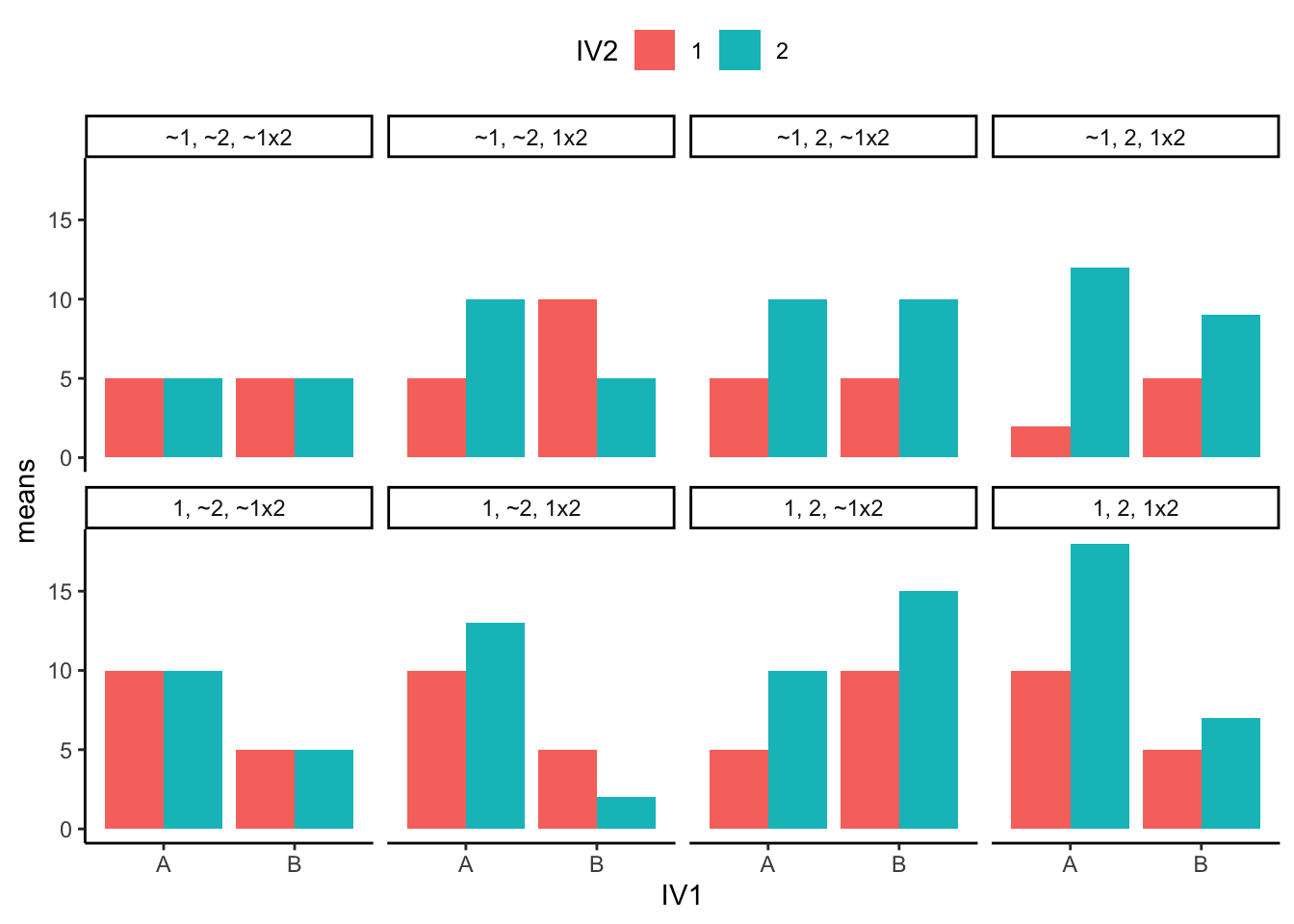
One independent variable was disgust, which the researchers manipulated by testing participants in a clean room or a messy room. The other was private body consciousness, a participant variable which the researchers simply measured. Another example is a study by Halle Brown and colleagues in which participants were exposed to several words that they were later asked to recall (Brown, Kosslyn, Delamater, Fama, & Barsky, 1999)[1]. Some were negative health-related words (e.g., tumor, coronary), and others were not health related (e.g., election, geometry). The nonmanipulated independent variable was whether participants were high or low in hypochondriasis (excessive concern with ordinary bodily symptoms). The result of this study was that the participants high in hypochondriasis were better than those low in hypochondriasis at recalling the health-related words, but they were no better at recalling the non-health-related words.

Note that this page is in the process of being updated
It’s when you become highly irritated and angry because you are very hungry…hangry. I will propose an experiment to measure conditions that are required to produce hangriness. The pretend experiment will measure hangriness (we ask people how hangry they are on a scale from 1-10, with 10 being most hangry, and 0 being not hangry at all). The first independent variable will be time since last meal (1 hour vs. 5 hours), and the second independent variable will be how tired someone is (not tired vs very tired). When the independent variable is a construct that can only be manipulated indirectly—such as emotions and other internal states—an additional measure of that independent variable is often included as a manipulation check.
The dependent variable, stress, is a construct that can be operationalized in different ways. For this reason, the researcher might have participants complete the paper-and-pencil Perceived Stress Scale and also measure their levels of the stress hormone cortisol. If the researcher finds that the different measures are affected by exercise in the same way, then he or she can be confident in the conclusion that exercise affects the more general construct of stress. Even if you are primarily interested in the relationship between an independent variable and one primary dependent variable, there are usually several more questions that you can answer easily by including multiple dependent variables. Most complex correlational research, however, does not fit neatly into a factorial design. Instead, it involves measuring several variables, often both categorical and quantitative, and then assessing the statistical relationships among them.
When the effect of one independent variable depends on the level of another. The study by Brown and her colleagues was inspired by the idea that people with hypochondriasis are especially attentive to any negative health-related information. This led to the hypothesis that people high in hypochondriasis would recall negative health-related words more accurately than people low in hypochondriasis but recall non-health-related words about the same as people low in hypochondriasis. The main effects all have 2 df, the three two-way interactions all have 4 df, and the three-way interaction has 8 df.
For example, all participants could be tested either while using a cell phone or while not using a cell phone and either during the day or during the night. This would mean that each participant was tested in one and only one condition. In a within-subjects factorial design, all of the independent variables are manipulated within subjects. All participants could be tested both while using a cell phone and while not using a cell phone and both during the day and during the night. The advantages and disadvantages of these two approaches are the same as those discussed in Chapter 4).
This would mean that each participant would be tested in one and only one condition. This would mean that each participant would need to be tested in all four conditions. The advantages and disadvantages of these two approaches are the same as those discussed in Chapter 5.
This variable, psychotherapy length, is represented along the x-axis, and the other variable (psychotherapy type) is represented by differently formatted lines. This is a line graph rather than a bar graph because the variable on the x-axis is quantitative with a small number of distinct levels. The research designs we have considered so far have been simple—focusing on a question about one variable or about a statistical relationship between two variables.
If you do this, then you simply have a single-factor design, and you are asking whether that single factor caused change in the measurement. For a 2x2 experiment, you do this twice, once for each independent variable. The number of possible purposes for mixing is very large and is increasing; hence, it is not possible to provide an exhaustive list. Greene et al.’s (1989) purposes, Bryman’s (2006) rationales, and our examples of a diversity of views were formulated as classifications on the basis of examination of many existing research studies. They indicate how the qualitative and quantitative research components of a study relate to each other. These purposes can be used post hoc to classify research or a priori in the design of a new study.
The first independent variable is light switch #1, and it has two levels, up or down. The second independent variable is light switch #2, and it also has two levels, up or down. When there are two independent variables, each with two levels, there are four total conditions that can be tested. Another common approach to including multiple dependent variables is to operationalize and measure the same construct, or closely related ones, in different ways. Imagine, for example, that a researcher conducts an experiment on the effect of daily exercise on stress.




No comments:
Post a Comment